
Virtually all firearms instructors refer to the 4 cardinal rules of firearms safety. While these cardinal rules may be worded slightly differently, the basic concept is the same.

The 4 cardinal rules are often posted at public ranges, and are read prior to handling firearms during a firearms training class.
Every accidental discharge of a firearm violates 1, if not all 4 of these rules. In the end, respect your firearm and always follow/practice basic gun safety rules.
We must always be responsible when in possession of a firearm. If you intend to go out drinking, you should not carry a firearm. If you’re sick, and taking a prescription medication that states on its label that the medicine could impair your ability to operate machinery, you should not carry a firearm. The bottom line is that we must make responsible decisions about when we should, or should not, carry a firearm. Think safety always.
Firearms (Handguns) Considerations
There is no substitute for consistent professional handgun skill development. Practice to improve your personal skills and understanding. These skills are perishable and you will lose them. You must practice to remain proficient.
A handgun is designed to protect you at close range, and while handguns are harder to shoot accurately, they are easier to keep control of during a struggle. You must be able to fire a handgun under stressful situations with confidence. One of the things that we can do to help with this, is to establish a skillset (usually through training). We should continue to practice our skills on a regular basis.

There are many different types and sizes of handguns to choose from in order to protect yourself. Before you buy for yourself, you should do some research. Many gun ranges rent handguns for you to use and try out. Practice and shoot different handguns to find out what you like. Be sure before you buy.
Firearms and Ammunition Storage
Cable Lock Usage: Handgun
Cable Lock Usage: Revolver
Cable Lock Usage: Rifle
Cable Lock Usage: Shotgun
Part of responsible gun ownership, is ensuring that our weapons are secure from unauthorized access when we are not using them, or not carrying them. We should always be in control of our weapons and who has access to them. “Control” can take place in several ways. “Control” could be: locking a weapon in a secure gun safe, or safely locking a weapon away with a gun lock secured to it in such a fashion that it is inoperable while the gun lock is in place. “Control” could be safely carried by you, in a manner that allows you to control who has access to it, and you have the ability to provide for the physical retention of the weapon. It is a growing trend that if a child gains access to a firearm and causes injury or death, the owner of that firearm may face criminal charges. If your weapon is not secured, or under your control, someone could be in danger.
After you are done using your firearm, lock it away. Do not leave it where anyone could get to it. In a drawer, in a closet, under some sweaters and on top of the refrigerator are examples of not locked away. You need to make the firearm and ammunition inaccessible to people that are unknowledgeable about safe gun handling. Locking the ammunition separately from the firearms adds yet another layer of security.
There are different types of storage for different types of firearms. A self-defense or home defense firearm might have a different type of storage need which allows for security, while still offering relatively quick access (i.e. RFID access or button access). Hunting or sporting firearms generally would have a lesser need for quick access (i.e. combination safes or key access safes).
When transporting firearms, or securing firearms in a vehicle, there are additional considerations.
- They should be secured in some fashion.
- Locking cases
- Cable locks
- Trigger locks
- Which part of the vehicle to transport in?
- Trunk vs. Glove Box
- Ammo should be separate
- Securing guns in the vehicle (for when you can’t carry where you are going)
- Vehicle Safes
- Bolted to vehicle
- Cable to vehicle
- Vehicle Safes
Remember: Your Oregon CHL is not valid in the state of Washington (or any other state). If you have to take your weapon with you to Washington, you need to make it inaccessible in your vehicle (where you can’t physically get to it while you drive). Before you cross the border, pull over to a place that is away from public view. With your weapon pointed in a safe direction, unload it and place the weapon in your trunk, vehicle safe or cable lock it. Place the ammunition in a different part of the vehicle away from the weapon (locked glove box, underneath a seat). The weapon and ammunition have to be separate and inaccessible to you as you drive for it, to be classified as not concealed.
Ammunition types
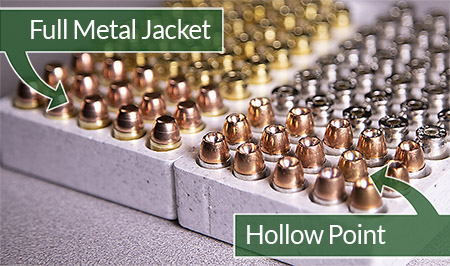
Regarding handgun ammo, there are basically two types of ammunition: hollow point and full metal jacket. Full metal jacket ammunition is used primarily for practice shooting and will generally cost less than hollow point ammunition. Try to use reputable brands of ammunition for practice so as not to damage your weapon.
Hollow point ammunition should be used while carrying your pistol for self-defense (conceal carry). Hollow point ammunition is designed to cause more trauma than a full metal jacket bullet which in turn provides more stopping power. There are many types and brands of hollow point ammunition. Go to an established firearms retailer and go to the gun and ammo counter. For the most part, the people who work behind the gun counter have training and certifications dealing with guns and ammunition. Ask a gun shop employee what a good personal defense round would be for your model of firearm. It should be from a reputable company and will cost more than practice ammunition. In the end, you will want to have very reliable ammunition in your weapon that will be carried for personal defense. Do not rely on ammo that you can buy cheap, in a zip lock bag from an unknown person standing at a gun show.
Source: Multnomah County Sheriff’s Office CHL Prep. chlprep.mcso.us/chlprep/
 Firearm Safety Team (FST)